Skip to product information
1 of 8
Bestsellerbio
Zertifizierungs-Siegel

Aristos-Olivenöl

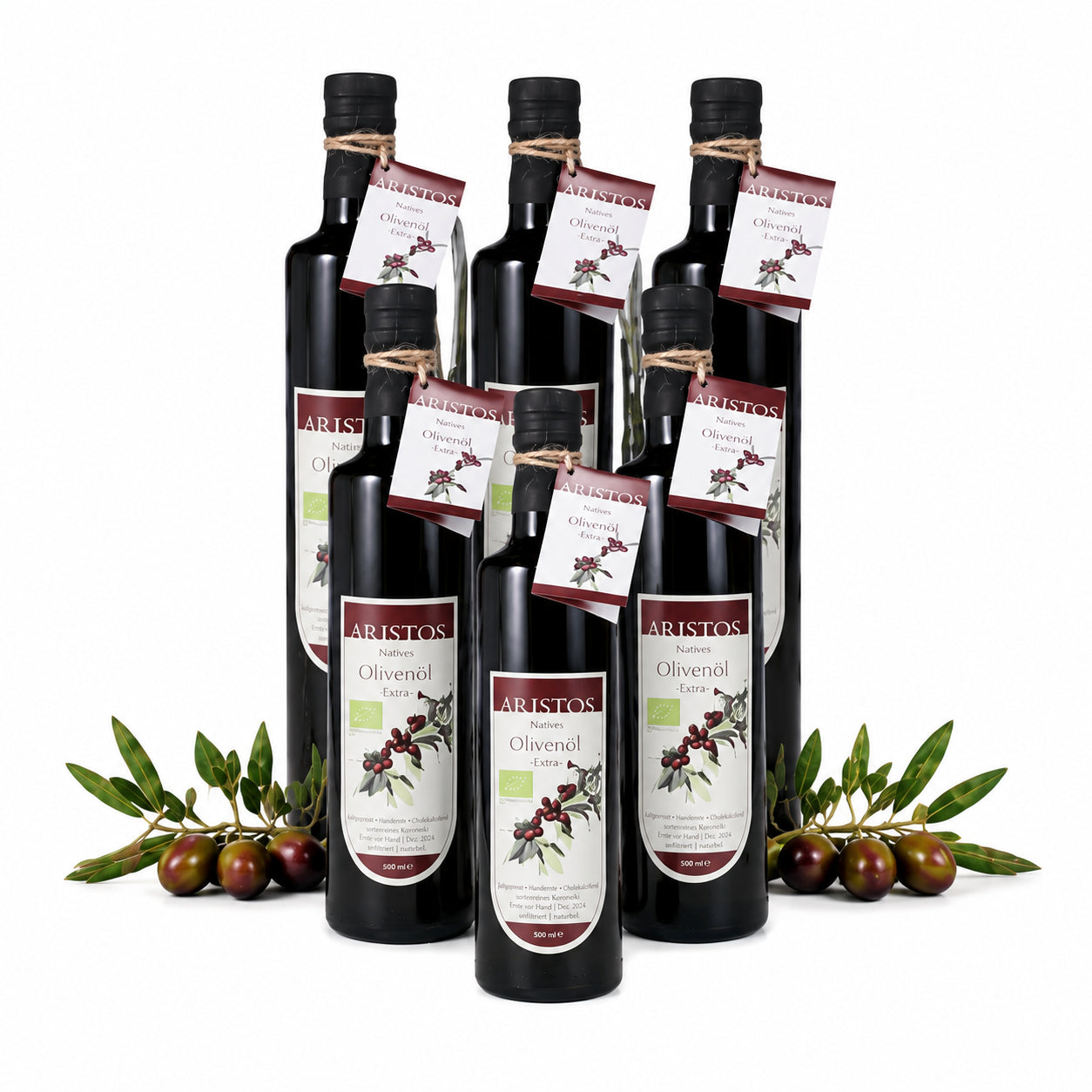
ARISTOS Organic Extra Virgin Olive Oil from Trikorfo Estate 500 ml - Jan 2026

<ul>
<li>Organic extra virgin olive oil from own cultivation<strong>
</strong></li>
<li><strong>NEW HARVEST FROM JANUARY 26, 2026 - from Koroneiki olives</strong></li>
<li>Don't be surprised: product labels are corrected by hand, new print data is on the way</li>
<li>Tiered prices (3 bottles 4% off, 6 bottles 4% off)</li>
<li>Content per bottle: 500 ml</li>
</ul>
Regular price 79,99 €
Sale price 79,99 € Regular price
Unit price 26,66 €  per  l
Tax included. Shipping calculated at checkout.

  • Natives Olivenöl Extra erste Güteklasse – direkt aus Oliven ausschließlich mit mechanischen Verfahren gewonnen
  • Von unseren Olivenbäumen
  • Abfüllung von Hand
Quantity
Auf Lager · Versand in 1–3 Werktagen
Payment methods
  • American Express
  • Apple Pay
  • Google Pay
  • Klarna
  • Maestro
  • Mastercard
  • PayPal
  • Shop Pay
  • Visa

ARISTOS Organic Extra Virgin Olive Oil from Trikorfo Estate 500 ml - Jan 2026

79,99 €

Das ARISTOS-Versprechen
"Wir möchten dir Transparenz in der Lieferkette bieten. In ARISTOS sollst du vertrauen können."
— Familie Karapatzakis, Herbrechtingen & Trikorfo

Description

Fresh ARISTOS extra virgin olive oil back in stock

Organic cold-pressed extra virgin olive oil from Trikorfo, Greece - our own product

Enjoy freshly pressed, cold-pressed organic olive oil from our home village Trikorfo in the mountains of Messenia. Our Koroneiki trees have been growing for generations in the middle of the mountains on a sheltered south-facing slope overlooking the city of Kalamata. The sun shines on our olive grove from morning to evening. The valuable red soil nourishes our fruits, and in December we harvest the small fruits and extract our valuable cold-pressed olive oil, which you can buy directly from us as the producer here.
The designation Extra Virgin stands for the highest quality class of cold-pressed olive oil. This designation ensures that your olive oil is free from sensory defects and that certain chemical analysis values (during production/processing and the producer's care) have not been exceeded. The epithet "Premium" is merely an attempt by various providers to differentiate themselves from ordinary extra virgin oils. In our opinion, this is due to the too low limits set.

Further information about (our) olive oil and our cultivation can be found here:

Fresh cold-pressed organic olive oil in conversion from our own production & marketing

Direkt vom Aristos Erzeuger
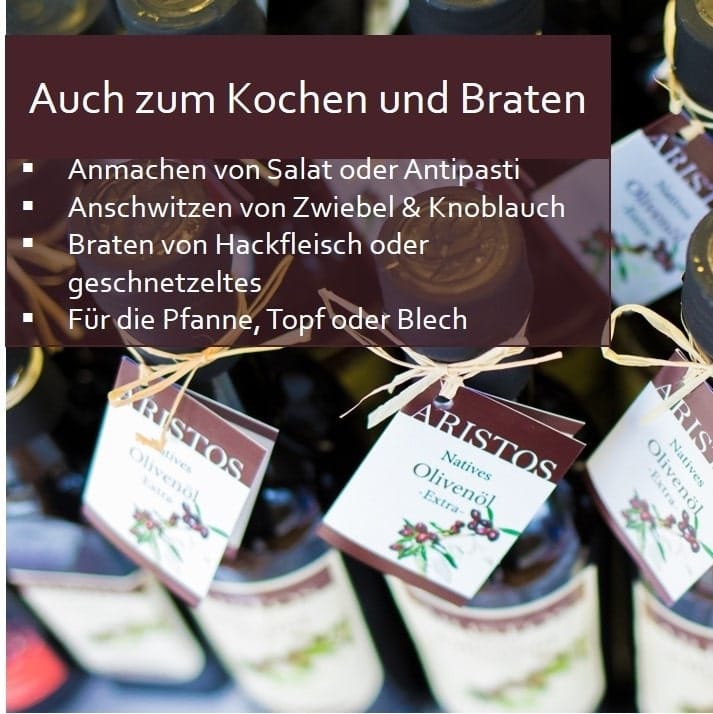
Kochen und Braten
  • We are the olive farmer
  • The bottler
  • The marketer
  • Our olive oil is an "all-rounder"
  • For cooking and frying
  • For salads & appetizers
Koroneiki Oliven
Mit extra nativem Olivenöl
  • Made from 100% Koroneiki olives
  • Without admixture of other oils
  • Varietal from our olive groves
  • Cold-pressed olive oil (at max 23°C)
  • Top analysis values (see below)
  • Freshly extracted every day

A journey to the harvest & production of our organic olive oil

Our homemade olive oil in the media

Presse Aristos 2014
  • We are olive oil professionals
  • On the market as experts since 2013
  • Fresh bottling daily
Presse Aristos 2020
  • We answer all your questions about olive oil
  • We help you with questions about your order
  • Premium olive oil from our own production

Guaranteed unfiltered cold-pressed organic olive oil

We only offer cold-extracted olive oil. During harvest season, the Koroneiki olives are processed into the finest olive oil every evening in our region's most modern oil mill. Traditionally, this is referred to as "cold-pressed" olive oil. However, this method is no longer current. Modern mills "centrifuge" the olive paste, thereby obtaining cold-centrifuged olive oil. We use the term cold-pressed synonymously to avoid confusing customers. We also offer an unadulterated, naturally cloudy olive oil for purchase. Some suppliers praise filtered olive oils, but we believe that filtered olive oil has been deprived of its natural pulp. Filtration, if desired, can also be done naturally by allowing the olive oil to settle. The pulp then settles at the bottom.

Our olive oil is suitable for cold and warm cuisine

The topic of cooking with olive oil is highly controversial. Depending on the source and supplier, you will find conflicting opinions and recommendations. Our recommendation as direct producers of olive oil is unequivocal: "Yes, you can also fry your schnitzel with our olive oil." It's suitable for cold cuisine anyway, and for warm cuisine too. What you should avoid is frying a fillet at the highest setting, searing it very sharply.
Its suitability for warm cuisine comes from the fact that you don't cook your vegetables or onions at the highest setting anyway. As long as you don't let your olive oil sizzle in the pan, our olive oil won't smoke. Most foods are gently fried; at the temperatures and times you heat the olive oil, there's no danger of exceeding its smoke point.

Our own Greek organic olive oil with a very high polyphenol content

Athanasios Karapatzakis Olivenöl Aristos

At the latest, once you've read the bestseller "Der Ernährungskompass" (The Nutrition Compass), you will delve into the topic of olive oil and polyphenols. Polyphenols are valuable antioxidants that protect our blood lipids from oxidative stress. The higher the concentration, the more precious the olive oil. For a health claim effect according to EU Regulation No. 432/2012, p.22, the extra virgin olive oil must have a concentration of 250 mg/kg olive oil polyphenols. We exceed this value every year. When it comes to polyphenols, we are at the forefront! Incidentally, advertising a high polyphenol content according to Health Claim Regulation 432/2012 is the only permitted characteristic that declares olive oil as health-promoting.

The current polyphenol content is 489 mg/kg. Harvest 2020 to 2021. Further declarative information on oleic acid etc. can be found in the additional information.

Our analysis values this year (according to EU Regulation 2568/91) are:

  •  Oleic acid: 0.27% - max. allowed: 0.80%
  • K270: 0.150 - max. allowed: 0.22
  • K232: 1.64 - max. allowed: 2.50
  • DK: -0.007 - max. allowed: < 0.01
  • Peroxide value: 4.6 meO²/kg - max. allowed: 20 meO²/kg
  • Waxes: 17 mg/kg - max. allowed: 250 mg/kg

Nutritional information of our olive oil

Information per 100 ml

  • Energy 3404 kJ / 825 Kcal
  • Fat 92 g
  • of which saturated 13 g
  • Carbohydrates 0
  • of which sugar 0
  • Protein 0
  • Salt 0

A direct look at our olive grove in Trikorfo

FAQ - The most important questions about our olive oil

Question 1: What exactly do these olive oil analysis values mean?

The oleic acid value indicates the proportion of free fatty acids. The lower the value, the more valuable the olive oil. But beware: according to our chemist in Greece, it is typical for organic olive oils that the oleic acid value in good years is on average higher than that of very good conventional olive oils.

The K270 value is a kind of age indicator. Fresh olive oils have a relatively low K270 value. Old olive oils, for example from previous years, naturally have a higher K270 value. This allows us to determine whether an olive oil has been blended or not.

The K232 value serves as a freshness indicator. Briefly explained, this value reflects how quickly harvested olives were processed. You can compare it to a bag full of apples left outside in the sun. The next day, they already start to ferment.

The DK value can be described as a purity indicator. The DK value of an extra virgin olive oil is always below 0.01 and ideally negative. If an olive oil has been adulterated with another edible oil, the DK value will inevitably be > 0.01.

The peroxide value indicates whether and to what extent olive oil has been exposed to oxygen. The maximum permitted value is 20. What does the number mean specifically? Some olive farmers and also olive oil bottling plants store their olive oil in food barrels that are not airtight. This means the good olive oil constantly comes into contact with fresh air and oxidizes. The peroxide value increases over time.

The values alone are not an indication of a wholesome olive oil. The type of olive oil is also a decisive factor.

Question 2: Is your olive oil free from mineral oil hydrocarbons (MOSH, POSH, MOAH)?

We are repeatedly asked whether our ARISTOS olive oil shows mineral oil residues. It is important to know that all oils can be affected. We also had our family product tested. Eurofins WEJ Contaminants GmbH found no indications for complaints at the time of analysis.

  • we work by hand
  • we do not use chainsaws (petrol)
  • we do not use branch chipping machines
  • we fill by hand, therefore no risk of contamination from bottling plants
  • we store our olive oil in 17-liter canisters and not in plastic containers
  • We store our oil in our cellar, so no risk of pollutant migration (plastic) due to heat

When Stiftung Warentest increasingly focused on the issue of contamination by MOSH, we had it tested again.

The corresponding report can be accessed here:

Report on mineral oil hydrocarbons.

Question 3: Can Aristos olive oil be heated?

It is true that, in moderation, you can essentially do anything with our olive oil.

  • Drinking oil
  • Oil pulling
  • Heating
  • Refining cold dishes

What matters is how you handle your olive oil when cooking.

In short: you shouldn't overdo it with the heat. This basically applies to all cold-pressed cooking oils. Naturally cloudy oils may have a lower boiling point, but you can still heat them.

If you are frying vegetables:

  • Medium to low heat and fry for a longer time

If you are frying onions or garlic:

  • Medium to rather low heat. If your onions don't become translucent but brown and black, the stove setting was generally too high.

If you are frying minced meat, schnitzel, or a steak:

  • Medium heat is perfectly sufficient here. Those who cook at too high a setting burn their food. Basically, it means: Cook longer rather than too quickly.

Question 4: How high are the Aristos polyphenols and what do they do?

Harvest DEZ 2024 408 mg/kg

Polyphenol content harvest 2020 to 2021 489 mg/kg.
Here laboratory proof 2020

Polyphenols are antioxidants that are measured in concentration mg per kg of olive oil. The higher the value, the (presumably) better. The brief statement about polyphenols is: "Protects blood lipids from oxidative stress."

Oxidative stress, simply put, is when the cells in our body form "oxygen radicals." And antioxidants are "free radical scavengers."

Hence the statement: "Polyphenols protect against oxidative stress."

Important: If you drink olive oil to protect yourself from oxidative stress, please do not follow the motto "more is more". That is not the case at all. The Health Claim Regulation "432/2012" clearly states: "The positive effect is achieved with a daily intake of 20 g of olive oil."

More consumption then simply enjoyment.

No.

It takes know-how to produce decent olive oil. From cultivation to harvest, the variety, the climate – everything contributes.

Question 5: What about animal welfare?

No. No birds are harmed with us or in the entire region. We harvest by hand and during the day. What was circulating in the media in 2019 only concerns gigantic ground-level agricultural facilities that work with harvesting machines. These are gigantic machines that wrap around the small trees and shake and vacuum off the olives. This harvesting process happens at night. At night, birds are disoriented and fly into the machines. This is not the case with us or generally on the Peloponnese.

Why not? Because we are on the mountain. We cannot work with such large tractor-like machines. There is no space... .

All key data about our Aristos olive oil summarized:

  • Cold-extracted extra virgin olive oil
  • Shelf life from olive oil production to consumption approx. 3 years with good storage
  • Directly from us as a producer from Greece
  • Natural, unfiltered, naturally cloudy
  • High-quality single-varietal Koroneiki olive oil
  • Unblended and without admixture of olive oil from other producers
  • First cold extraction at approx. 23°C
  • Thereby we extract only the most valuable active ingredients of the olive oil
  • Harvested and extracted in December 2020
  • Polyphenol test results were approximately 490 mg per kilogram
  • Traditional hand harvest with sticks and rakes
  • From traditional agriculture with trees that have been family-owned for generations
  • Sun-drenched from the village of Trikorfo near Kalamata, Greece
  • Aristos olive oil for cold and warm cuisine
  • A high-quality olive oil for cooking & frying
  • For dressing salads, antipasti or pesto
  • We bottle weekly in green glass
  • Bottled in 500 ml bottles
  • Bottled directly by us in 89542 Herbrechtingen
  • Publication of the chemical analysis according to EU Regulation No. 2568/91 directly on the label

We are the family that produces this olive oil from our own cultivation

Dimitrios Karapatzakis

Dimitrios

Founder | Olive grove care & harvest | Pickling olives | Farmers' markets

Wassiliki Paraskevopoulou

Wassiliki

Olive oil bottling | Gift design | Food packaging | Recipes & more

Athanasios Karapatzakis

Athanasios

Founder | Olive grove care & harvest | Partnerships | Social projects

100% biologisches Olivenöl

Energie 3404 kJ / 825 Kcal

Fett 92 g

davon gesättigt 13 g

Kohlenhydrate 0

davon Zucker 0

Eiweiß 0

Salz 0

Häufig gestellte Fragen

Häufige Fragen zu diesem Produkt werden in Kürze ergänzt. Haben Sie eine spezifische Frage? Schreib uns gerne direkt – wir antworten persönlich.

DIREKT AUS UNSERER HEIMAT

Wir bringen dir Griechenland – so wie es wirklich schmeckt.

01
WO WIR HERKOMMEN

Trikorfo, Messenien – das Dorf unserer Familie

Unsere Wurzeln liegen in Trikorfo, einem kleinen Dorf in den Bergen Messeniens. Hier besitzen wir seit drei Generationen eigene Haine und kennen die Erzeuger unserer anderen Produkte persönlich. Nicht vom Katalog – sondern vom gemeinsamen Mittagessen.
02
WIE WIR ARBEITEN

Von Hand gepflückt – für beste Qualität

Ob Oliven, Orangen oder Pistazien: Wir setzen auf sorgfältige Handernte. Dimi fährt jedes Jahr nach Trikorfo, um selbst bei der Ernte dabei zu sein. Denn nur wer vor Ort ist, weiß wirklich, was in deinem Paket landet.
03
WIE WIR VERARBEITEN

Frisch verarbeitet – bevor der Tag vorbei ist

Was morgens geerntet wird, kommt noch am selben Tag in die Mühle oder in die Manufaktur. Ob Olivenöl, Aufstriche oder eingelegte Oliven – wir verarbeiten alles in kleinen Mengen, nach traditionellen Rezepten, ohne Umwege über Zwischenhändler.
01
WIE WIR DICH BELIEFERN

Direkt von unserer Familie zu dir

Wir füllen ab, verpacken und verschicken selbst – von Herbrechtingen aus, direkt zu dir. Keine Logistikzentren, kein anonymes Lager. Wenn du eine Frage zu deiner Bestellung hast, erreichst du Atha oder Wassiliki persönlich. So wie sich das für einen Familienbetrieb gehört.

Wir sind das Team hinter ARISTOS

  • Dimitrios

    Gründer | Pflege & Ernte im Olivenhain | Einlegen von Oliven | Wochenmärkte

  • Wassiliki

    Olivenöl Abfüllung | Geschenke gestalten | Lebensmittel verpacken | Rezepte & mehr

  • Athanasios

    Gründer | Pflege & Ernte im Olivenhain | Partnerschaften | Soziale Projekte

1 of 3